Aug.31,2026
What You Need to Know about Oil-Immersed Transformer starts with one basic definition: an oil-immersed transformer is an electrical transformer whose core and windings are submerged in insulating liquid. The liquid provides dielectric insulation between energized components and transfers heat from the windings and core to the tank, radiators, or cooling equipment. These transformers are widely used in substations, industrial facilities, distribution networks, renewable energy systems, and utility-scale power applications.
I consider oil-immersed transformers a practical choice when a project requires substantial transformer load capacity, controlled operating temperature, outdoor installation, and long service intervals. However, selecting the correct unit requires more than matching the rated kVA or MVA. The buyer must also evaluate insulation level, impedance, vector group, losses, tap-changing requirements, protection devices, installation conditions, testing records, and the total cost of ownership.
!
An oil-immersed transformer is a static electrical device that transfers alternating-current power between voltage levels through electromagnetic induction. Its magnetic core and copper or aluminum windings are placed inside a sealed or conservator-type tank filled with transformer oil or another approved insulating liquid. The liquid performs two essential functions: it increases insulation strength and removes heat generated during operation.
The transformer normally includes a magnetic core, high-voltage winding, low-voltage winding, insulation system, tank, bushings, cooling surfaces, tap changer, and protective accessories. Depending on the design, it may also include a conservator, breather, Buchholz relay, pressure relief device, oil level indicator, winding temperature indicator, and surge protection interface.
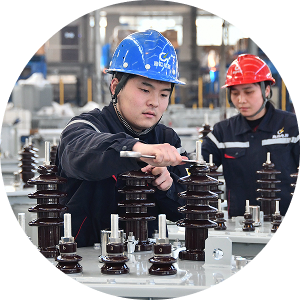
The main applications include distribution substations, industrial plants, commercial power networks, rail electrification, photovoltaic plants, wind farms, charging infrastructure, and utility transmission systems. Hebei Gaojing Electrical Equipment Co., Ltd. develops and manufactures oil-immersed transformers alongside dry-type transformers, box-type substations, high- and low-voltage equipment, iron cores, and new-energy charging equipment.
The operating principle is based on electromagnetic induction. When alternating voltage is applied to the primary winding, it creates an alternating magnetic flux in the core. That changing flux induces a voltage in the secondary winding, with the voltage ratio determined primarily by the turns ratio between the two windings.
The core is usually manufactured from laminated silicon steel or amorphous alloy material. Laminations reduce eddy-current losses, while the core shape and joint design influence magnetizing current, noise, mechanical strength, and no-load loss. Gaojing’s product range includes silicon-steel laminated-core transformers, silicon-steel three-dimensional toroidal-core transformers, and amorphous-alloy three-dimensional toroidal-core transformers.
Transformer oil surrounds the windings and core, filling small air gaps in the insulation system. Because oil generally has greater dielectric strength than air, it allows the transformer to use a compact internal arrangement while maintaining electrical clearances. The oil also absorbs heat from the windings and transfers it to the tank walls, radiators, or forced-cooling equipment.
Cooling classifications describe how oil and air circulate through the transformer. The most common arrangements include:
For a small outdoor distribution transformer, natural oil and air circulation may be sufficient. Larger industrial or utility transformers may need radiators, fans, pumps, or heat exchangers to maintain winding and oil temperatures during high-load operation. The selected cooling method must match ambient temperature, altitude, load profile, enclosure design, and required overload capability.
I classify oil-immersed transformers according to their application, core construction, winding arrangement, cooling method, and tap-changing configuration. This classification helps buyers compare equipment with similar electrical functions but different operating and lifecycle characteristics.
Distribution transformers reduce medium voltage to the lower voltage required by factories, buildings, farms, commercial sites, and local utility networks. They are commonly installed outdoors or inside substations and may use sealed tanks or conservator systems. For a small substation, the most important specifications are rated capacity, primary and secondary voltage, frequency, impedance, vector group, short-circuit withstand, and no-load and load losses.
Power transformers are used at higher capacities and voltage levels, often in utility substations, transmission systems, industrial complexes, and large renewable energy projects. Their designs may include multiple cooling stages, on-load tap changers, conservators, radiators, online monitoring, and more extensive protection equipment. A power transformer specification should identify the system fault level, insulation coordination, BIL, switching conditions, neutral arrangement, and expected operating profile.
Three-dimensional toroidal-core transformers use a closed magnetic circuit designed around a three-phase core structure. The geometry can reduce magnetic circuit discontinuities and may influence material usage, vibration, noise, and no-load performance. Gaojing manufactures three-phase oil-immersed silicon-steel and amorphous-alloy three-dimensional toroidal-core transformer products.
Amorphous-alloy cores use rapidly solidified metallic strips with different magnetic characteristics from conventional grain-oriented silicon steel. Their primary purchasing rationale is usually reduced no-load loss, especially in transformers that remain energized for long periods with variable loading. The buyer should request measured loss data at the specified voltage and frequency rather than relying only on the core material name.
An off-load tap changer adjusts the turns ratio while the transformer is de-energized. An on-load tap changer adjusts voltage while the transformer remains in service, but it adds mechanical, electrical, and maintenance requirements. The selection depends on voltage variation, network regulation, switching frequency, control philosophy, and the availability of trained maintenance personnel.
The main reason to use an oil-immersed transformer is the combined insulation and cooling function of the liquid system. Oil-based cooling can support high transformer load capacity in a relatively compact enclosure, particularly when radiators, fans, or pumps are added. Oil-immersed designs are also widely standardized, making them suitable for utility, industrial, and renewable-energy applications.
Another benefit is the range of available configurations. Buyers can specify different voltage ratios, vector groups, impedance values, tap ranges, cooling classes, core materials, enclosure designs, and monitoring accessories. This flexibility is useful when a transformer must connect a factory distribution system, solar inverter block, wind farm collector network, or box-type substation.
The limitations are linked mainly to the insulating liquid and installation environment. Mineral oil is combustible, so the installation may require fire separation, bunding or containment, drainage control, fire detection, suppression equipment, and minimum clearances. Oil leaks can contaminate soil or drainage systems, while moisture, oxidation, particles, and dissolved gases can reduce insulation reliability.
| Evaluation factor | Oil-immersed transformer implication |
|---|---|
| Efficiency | Compare guaranteed no-load and load losses at specified test conditions |
| Capacity | Suitable for distribution, industrial, utility, and renewable applications |
| Cooling | Natural or forced oil and air circulation can support different load profiles |
| Fire protection | Requires a site-specific risk assessment and containment design |
| Maintenance | Includes oil testing, leak inspection, temperature checks, and protection testing |
| Installation | Requires a suitable foundation, grounding, clearances, lifting access, and drainage |
| Environmental control | Oil handling and disposal procedures must be defined before commissioning |
The difference between oil-immersed and dry-type transformers is primarily the insulation and cooling medium. An oil-immersed transformer uses liquid insulation around its core and windings, while a dry-type transformer uses air and solid insulation materials such as resin or varnish systems. This difference affects fire protection, installation location, maintenance, overload behavior, and cost.
Dry-type transformers are often selected for indoor locations, buildings, tunnels, hospitals, data centers, and sites where liquid containment is difficult. Oil-immersed transformers are frequently selected for outdoor substations, utility distribution, industrial facilities, and applications requiring higher capacity or extended heat-transfer capability.
| Factor | Oil-immersed transformer | Dry-type transformer |
|---|---|---|
| Cooling medium | Insulating oil or approved liquid | Air with solid insulation |
| Fire considerations | Requires liquid-fire risk controls | Lower liquid-fire risk |
| Outdoor suitability | Commonly suited to outdoor substations | Requires enclosure and environmental protection |
| Maintenance | Includes oil sampling and analysis | Focuses on winding, ventilation, and connection inspection |
| Capacity range | Broad range, including high-capacity units | Broad, but thermal design may limit some applications |
| Environmental risk | Requires leak prevention and oil management | No insulating-oil leakage |
| Installation cost | May require containment and fire measures | May require larger ventilation or enclosure arrangements |
| Typical applications | Utility, industrial, renewable, and distribution substations | Indoor commercial, industrial, and special-purpose installations |
I would not select one type based only on purchase price. The correct comparison must include transformer losses, installation requirements, fire protection, available floor area, cooling conditions, maintenance labor, expected load profile, and the financial effect of an outage.
Before requesting quotations, I prepare a technical schedule that defines the transformer’s electrical and mechanical requirements. The schedule should identify rated power, primary and secondary voltage, frequency, phase arrangement, connection symbol, neutral configuration, impedance, tap range, cooling class, insulation level, BIL, enclosure type, altitude, ambient temperature, and installation location.
I also specify the applicable design and testing framework. Depending on the project and jurisdiction, the purchase documents may reference the IEC 60076 transformer series, applicable IEEE C57 standards, local electrical codes, and utility-specific requirements. The quotation should clearly state whether the proposed ratings are guaranteed values, routine-test values, design targets, or optional features.
Losses deserve separate attention because they affect operating cost throughout the transformer’s service life. I request guaranteed no-load loss, load loss at the reference temperature, total loss, sound level, temperature-rise limits, efficiency data, and tolerance conditions. A lower initial price may be offset by higher losses if the transformer remains energized continuously or operates near rated load for many hours each year.
The purchasing package should also list required accessories and documents:
Gaojing reports that it was founded in 2008 and operates from a company area of approximately 100,000 square meters with more than 6 automated production workshops and over 600 employees. Its reported product and project scope includes energy-saving transformers, box-type substations, complete distribution equipment, and new-energy applications, so I would still require a project-specific technical offer rather than evaluating a manufacturer from general product categories alone.
I begin commissioning with a transport and receiving inspection. The team should check the tank, bushings, radiators, valves, conservator, cable boxes, lifting points, impact indicators, oil level, and accessory crates for damage. Any abnormal pressure, denting, oil leakage, broken porcelain, or displaced component should be documented before installation.
The foundation must support the transformer’s static weight, dynamic forces, wheels or skids, and seismic or wind requirements where applicable. The installation layout should provide access for inspection, radiator airflow, oil drainage, cable termination, lifting equipment, fire protection, and future replacement. Grounding conductors should be connected to the tank and other designated points according to the approved protection and earthing design.
Before energization, I verify oil level, oil appearance, insulation resistance, winding resistance, turns ratio, winding polarity or vector group, protective relay wiring, tap-changer position, bushing connections, control circuits, and grounding continuity. Oil samples should be taken using clean sampling equipment and labeled with the transformer identification, location, date, temperature, and sampling point.
For a transformer that has been opened, transported under abnormal conditions, or exposed to moisture, the commissioning plan may require vacuum treatment, oil filtration, drying, or extended settling time. Initial energization should normally occur without load or at a controlled low-load condition, followed by checks for abnormal sound, vibration, leakage, temperature rise, relay operation, and voltage balance.
I establish baseline measurements during the first operating period. These records should include oil temperature, winding temperature, load current, voltage, power factor where available, fan or pump status, dissolved-gas results, and thermographic images. A baseline allows later changes to be separated from normal operating variation.
Oil-immersed transformer maintenance should combine routine visual inspection with scheduled electrical and oil-condition testing. Operators should inspect oil level, leakage, tank corrosion, bushing condition, breather condition, radiator valves, cable connections, grounding, abnormal sound, and temperature indicators. The inspection interval should reflect the transformer’s voltage class, loading, environment, switching frequency, and manufacturer instructions.
Transformer oil testing provides information that cannot be obtained from external inspection alone. Typical tests include dielectric breakdown strength, moisture content, acidity, interfacial tension, resistivity, color, inhibitor condition, particle contamination, and dissolved gas analysis. Furan testing can help assess paper insulation aging, while oil quality trends can indicate oxidation, contamination, or moisture ingress.
I use a symptom-to-test decision process rather than replacing parts without evidence:
| Observed symptom | Initial diagnostic focus |
|---|---|
| Overheating at normal load | Thermography, temperature records, cooling-system inspection, winding resistance |
| Gas generation or relay operation | Dissolved gas analysis, Buchholz relay inspection, oil sampling |
| High moisture indication | Moisture analysis, breather inspection, gasket and seal inspection |
| Dark or discolored oil | Acidity, dielectric strength, particle count, oxidation-related tests |
| Increasing noise or vibration | Thermography, mechanical inspection, grounding check, winding resistance |
| Visible oil leakage | Tank welds, valves, gaskets, bushings, conservator, pressure conditions |
| Uneven phase temperature | Load balance check, connection inspection, winding resistance, thermal imaging |
Online monitoring can extend this approach by using online DGA, fiber-optic temperature sensors, moisture sensors, load-current measurement, and IoT gateways. These systems are particularly useful for remote substations, renewable energy systems with variable output, and industrial sites where an unexpected outage has a high production cost.
The cost of an oil-immersed transformer includes more than the quoted equipment price. I calculate total cost of ownership by combining purchase price, transportation, civil works, oil containment, fire protection, installation labor, commissioning tests, energy losses, oil testing, spare parts, monitoring, planned maintenance, unplanned repairs, and downtime.
A simple evaluation model is:
Lifecycle cost = purchase and installation cost + energy-loss cost + maintenance cost + risk and downtime cost − residual value
No-load loss occurs whenever the transformer is energized, even when it carries little load. Load loss changes with current and generally increases approximately with the square of the load current, so the annual operating profile is essential when comparing transformer designs. I ask suppliers to provide loss guarantees under the same voltage, frequency, temperature, and test standard so that quotations can be compared fairly.
Fire protection and containment may materially affect the project budget. These costs can include bund walls, oil collection pits, drainage isolation, separation distances, fire detection, suppression equipment, and environmental response materials. A transformer with a lower purchase price may not produce the lowest lifecycle cost if its losses, maintenance burden, or site protection requirements are greater.
I recommend selecting the transformer through a documented engineering and purchasing review:
For a factory, I pay particular attention to starting currents, production continuity, indoor or outdoor placement, fault level, harmonic-producing equipment, and future expansion. For a renewable energy system, I also evaluate rapid load variation, inverter behavior, collector voltage, reverse power conditions, ambient temperature, and remote monitoring requirements.
What You Need to Know about Oil-immersed Transformer selection is that the equipment is both a voltage-conversion device and a thermal-insulation system. The core and windings transfer energy through electromagnetic induction, while transformer oil provides dielectric insulation and removes heat. This design supports many distribution, industrial, substation, and renewable-energy applications, but it also requires planned fire protection, oil containment, testing, and maintenance.
I would choose an oil-immersed transformer when its capacity, cooling method, insulation system, losses, installation conditions, and lifecycle cost match the project requirements. Before purchase, I would compare IEC or IEEE requirements, BIL, impedance, vector group, tap changer, guaranteed losses, accessories, factory tests, commissioning procedures, and documentation. After installation, I would establish baseline measurements and maintain a condition record using oil analysis, DGA, thermography, temperature data, and protection-device inspections.
Require More Customized Solutions?
We offer customization to meet your specific needs. Our expert team will collaborate with you to develop the perfect product for you
Navigation
Navigation
Contact Us
Tel: +86 188 3000 9955
E-mail: gjscb@hbgjdq.com
WeChat: zjj9232013
Add.: No.118, Luchan Road, Yongnian District, Handan City, Hebei Province, China
Send in Inquiry
Send in Inquiry